
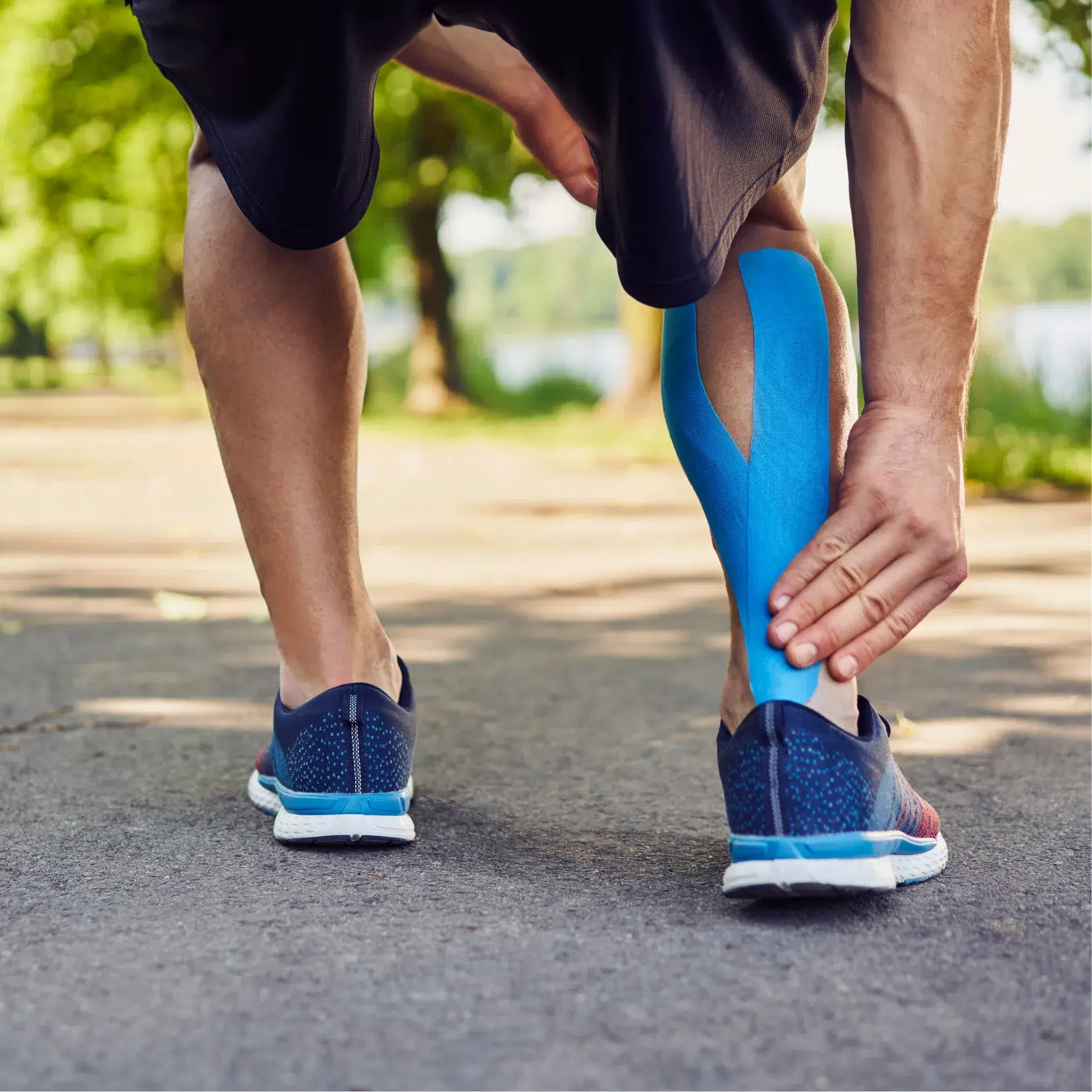
Have you been struggling with pain in your Achilles tendon? Has it stopped you from reaching your potential by playing sports, running, walking, gardening or your day-to-day activities?
It may be time to get a formal assessment by a physiotherapist to start you on a rehabilitation plan.
Achilles tendinopathy:
The calf muscles (gastrocnemius and soleus) attach to the heel bone via the Achilles tendon. The Achilles tendon is the thickest in our body and can absorb a large amount of load (up to 8 times your body weight) and can also generate a large amount of force.
Achilles tendinopathy is the term used to describe pain and dysfunction in your Achilles tendon. Achilles Tendinitis and Tendinosis are generally discouraged from use as inflammation is a normal process of tendon adaptation. Tendinosis describes degeneration in the tendon; however, it is very common to have pathology/collagen disorganisation in asymptomatic people.
There are two types of Achilles Tendinopathy: mid-portion and insertional. Mid portion being the most common type of Achilles Tedniopathy.
How did you get Achilles tendon pain?
To simplify why you have Achilles tendon pain, it is usually due to doing too much too soon without having the tendon capacity to tolerate the imposed demands. Every individual’s tolerance is different due to their history of sports, strength training, genetics, frequency, intensity and volume of training.
Should you be worried if your tendon has thickened? In short no. The surface area of a tendon thickens as a compensatory mechanism to maintain tissue homeostasis and is a positive adaptation to load.
How to treat Achilles Tendinopathy:
The primary goal of rehab is so the capacity of the Achilles Tendon exceeds the demands imposed on it such as the intensity, frequency and volume of activity (e.g. running).
- Improve your tolerance to load through a rehabilitation program that improves Achilles tendon, calf and lower limb strength/function.
- Discuss and target any other contributing factors up the kinetic chain, stress, sleep, nutrition and load management.
- Can you rehabilitate with some degree of pain? Yes. Exercising within a tolerable level of pain that works for the individual is acceptable.
- How do you know if you have pushed it? Monitor pain levels the morning after, generally, if your pain level the next day after exercise is 5/10 or greater, you may need to reduce your volume or intensity.
- A common mistake is chronically underloading the Achilles tendon or doing too much which results in flare-ups. Both scenarios will underload the tendon chronically which results in the capacity being diminished. Because of this, a structured and tailored rehabilitation program is important.
Components of a rehabilitation program:
A common mistake in a rehabilitation program is not completing all stages of strengthening. Tendons are designed to store and release large amounts of energy.
Isometric exercises are recommended during the acute stage of Achilles tendon rehab. These are slowly progressed to heavy but slow resistance exercises through the full range.
Once you are able to tolerate heavy exercises, it is important to load the Achilles tendon through faster movements which are commonly in the form of plyometric exercises. This stage is often neglected but it is very important to implement them as part of a rehabilitation program to ensure the achilles tendon can build capacity to store and release energy.
Remember to be patient. Achilles tendinopathy rehab can take anything from 3-12 months. A structured rehabilitation program can help increase tendon capacity and improve load tolerance, whilst navigating flare-ups and modifying activity as necessary.